
What Makes a Trillionaire?
How Civilization Measures Those Who Attempt the Impossible

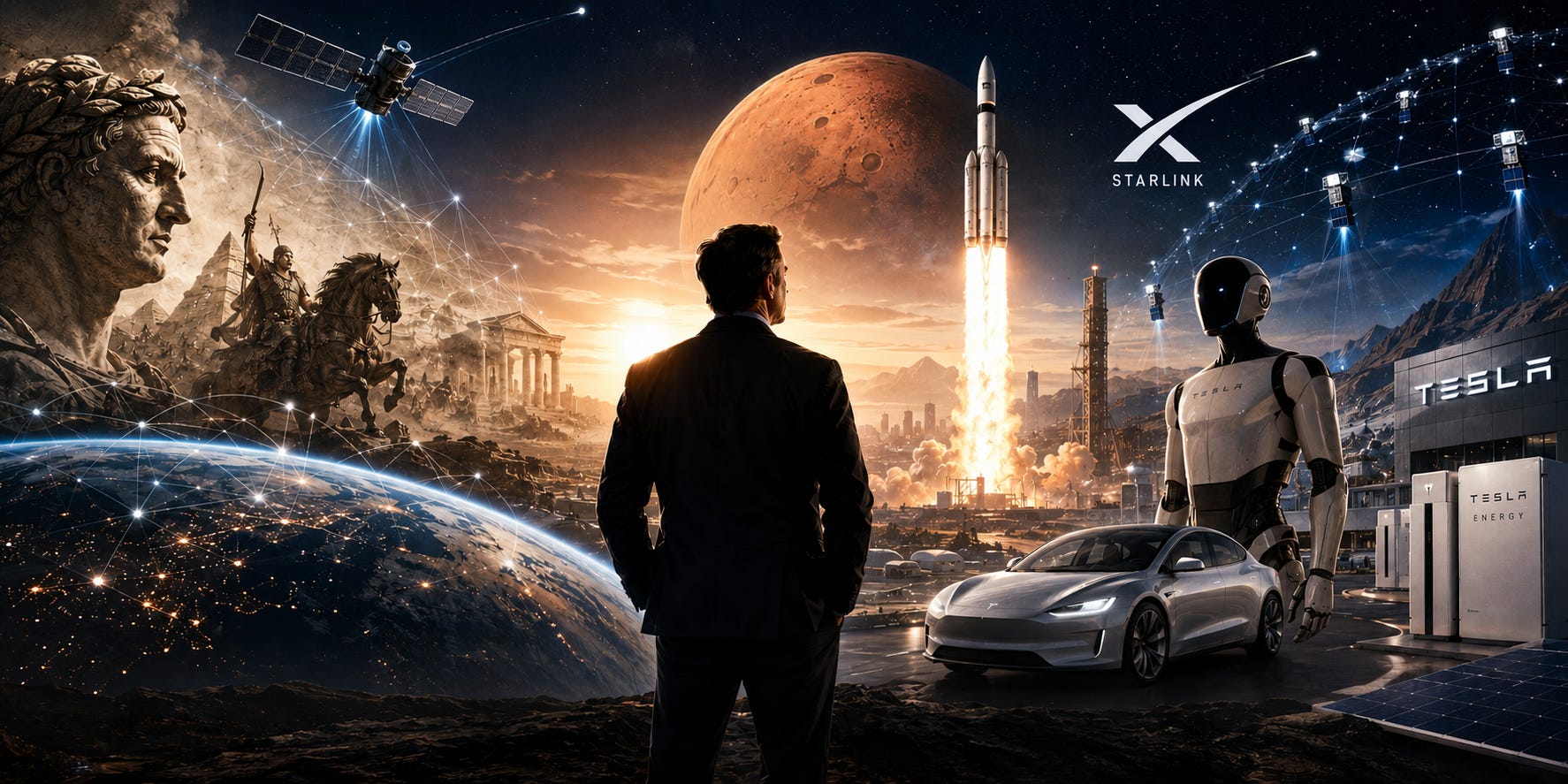
I’ve heard a quote recently that, whether it’s literally true or not, captures something interesting about how wealth scales in the modern world.
“A millionaire changes your life in some way. A billionaire changes your life every day.”
The point isn’t that every billionaire personally affects your daily routine. It’s that somewhere between a million dollars and a billion dollars, wealth stops being about improving one person’s life and starts becoming capable of reshaping entire industries.
Thanks to recent events, that raises a new question…
What exactly does someone have to change in order to become a trillionaire?
History has certainly produced people whose fortunes, adjusted for today, may have approached or even exceeded a trillion dollars. Emperors, conquerors, and kings amassed extraordinary wealth through expanding borders, controlling trade routes, taxing entire populations, or claiming the resources of vast territories. Figures such as Julius Caesar and Attila the Hun commanded wealth on a scale that is difficult to comprehend, but that wealth was largely inseparable from political power, military conquest, or hereditary rule.
There’s nothing “simple” about building an empire, history reminds us that doing so required immense political, military, and organizational ability. But the source of that wealth was fundamentally different. Their fortunes were accumulated by controlling nations.
Elon Musk, whether history ultimately judges him as a visionary or a cautionary tale, has arrived at the doorstep of a trillion dollar valuation by a completely different route. He didn’t inherit an empire. He didn’t conquer one. Instead, he built companies that convinced millions of customers and investors they were creating the future. Tesla accelerated the transition to electric vehicles. SpaceX fundamentally changed the economics of reaching space through reusable rockets. Starlink connected parts of the world that traditional infrastructure had left behind. Whether those accomplishments ultimately prove to be overwhelmingly beneficial or produce consequences we can’t foresee is a question history hasn’t answered yet.
Until recently, the very idea of a trillionaire belonged somewhere between science fiction and economics textbooks. A trillion dollars is such an incomprehensible amount of wealth that our brains almost refuse to process it. Consider this, one million seconds is about twelve days. One billion seconds is nearly thirty two years. One trillion seconds is more than 31,000 years, that’s longer than the span of recorded human civilization. That's the kind of number we're talking about. We understand what a million dollars can buy. We can even picture what a billionaire's life might look like, private jets, yachts, vacation homes, companies with household names. But a trillion dollars? There is no lifestyle that requires a trillion dollars. There isn't a mansion large enough or a garage filled with enough exotic cars to explain it.
Perhaps that’s because a trillion dollars isn’t really about consumption at all.
Maybe it’s about impact.
Building the Future
More specifically, maybe it’s about attempting something so absurdly ambitious that the market begins valuing not simply the companies you’ve built, but the future those companies are trying to create.
The more I looked at Elon Musk’s collection of companies, the harder it became to see them as unrelated businesses. At first glance they’re scattered across completely different industries. Electric vehicles. Rockets. Satellites. Artificial intelligence. Robotics. Energy storage. But look a little closer and a pattern begins to emerge.
Suppose, just for a moment, that your objective wasn’t to build the world’s largest car company or the world’s most valuable rocket company. Suppose your objective was to build a self sustaining civilization on Mars. Suddenly the companies begin to make a surprising amount of sense.
You need rockets capable of transporting enormous amounts of cargo to another planet repeatedly without discarding them after every launch. SpaceX makes that problem economically feasible.
You need a communications network that doesn’t rely on laying fiber optic cable across impossible terrain. Starlink demonstrates how a constellation of satellites can connect an entire world.
You need autonomous machines capable of working where people cannot, especially in the dangerous early years before a colony becomes self sufficient. Tesla’s Optimus program suddenly becomes more than a factory robot. It becomes a worker that doesn’t require oxygen, doesn’t complain about radiation, and can operate around the clock in an environment that would kill a human being.
You need vehicles that can navigate without constant human input because there won’t always be enough trained drivers on another planet. Years of developing autonomous driving technology become valuable for reasons extending far beyond traffic on Earth.
You need enormous amounts of reliable energy. You need batteries. You need artificial intelligence capable of coordinating increasingly complex systems. You need manufacturing techniques that can produce as much as possible with as few human hands as possible.
Individually, each company appears ambitious.
Viewed together, they begin to resemble pieces of a blueprint.
Now, perhaps that’s exactly what they are, but maybe it isn’t. Only Elon Musk knows how much of this integration is intentional versus the natural overlap of solving difficult engineering problems. It’s entirely possible that history will look back and conclude people connected dots that were never meant to be connected, but it’s difficult to ignore how neatly they fit together.
For thousands of years humanity has looked toward the stars and imagined what it would mean to become an interplanetary species. Philosophers dreamed about it. Writers imagined it. Scientists calculated it. Nobody has attempted to build the infrastructure required to actually do it until now. Whether the dream succeeds is almost secondary.
The attempt itself may explain something about the trillion dollar question. Markets don’t merely reward present success. They’re constantly trying to price the future.
If investors genuinely believe someone is building technologies capable of fundamentally changing the trajectory of civilization, not just improving the next product cycle, it shouldn’t surprise us that the valuation attached to those companies begins reaching numbers that seem detached from reality.
Perhaps that’s what a trillion dollars represents. Not a man’s lifestyle. Not even his companies. But the possibility, however remote, that his work could permanently alter the human story.
The Weight of Influence
Of course, that’s also where the conversation becomes considerably more uncomfortable.
If your companies become responsible for transportation, communications, artificial intelligence, robotics, and eventually the first permanent settlement on another world, the question is no longer whether you’ve earned extraordinary wealth.
The question becomes whether any one person, or any one corporation, should possess that much influence over humanity’s future. History has always been wary of concentrated power.
Becoming an interplanetary civilization may force us to ask that question on an entirely new scale.
History may ultimately decide that Elon Musk failed. Mars could remain nothing more than an ambitious dream. Autonomous robots may never build cities beneath alien skies. Reusable rockets, satellite constellations, and artificial intelligence may ultimately be remembered as remarkable technological achievements rather than the foundation of humanity’s next chapter.
Then again...
They might not.
History has never rewarded certainty. It rewards those willing to attempt what everyone else considered impossible. Maybe that’s what makes a trillionaire so different from every level of wealth that came before it.
A millionaire solves problems.
A billionaire transforms industries.
A trillionaire transforms civilization.
That doesn’t guarantee success. It doesn’t guarantee wisdom. It certainly doesn’t guarantee virtue. But it does explain why the market would ever attempt to assign such an incomprehensible value to a single individual in the first place.
For most of human history, the wealthiest people became rich because they controlled humanity. Maybe, for the first time, the wealthiest person in history is attempting to expand it. If that ambition succeeds, even in part, the first trillion dollars will never have been the remarkable achievement. It will simply have been our way of trying to measure the value of changing the course of humanity.
— Ethan Paine